
Editor’s Note: In today’s article, Ramon Ramirez takes a look at the Springfield Armory 1911 Emissary 4.25″ AOS pistol chambered for the 9x19mm Parabellum cartridge as a modern self-defense handgun. The firearm was provided to the author by the company for this article.
I didn’t step into the firearms space thinking reviews were going to become the main focus. That wasn’t the plan. Like most things, it developed over time.
I was already spending time behind pistols, already paying attention to how they behaved — how they tracked in recoil, how they grouped, how they held up once the round count started climbing. At some point, the evaluation side of it became just as interesting as the shooting itself.
Service-Grade Perspective
So here we are, and here’s my take on the Springfield Armory 1911 Emissary 4.25” AOS 9mm pistol. I think it matters to be clear about the perspective I’m bringing to the table. My background is service-grade. I’m not chasing competition stage times, and I’m not approaching pistols from a gunsmith’s bench. I’m looking at them as working tools. Reliability, recoil behavior, practical accuracy, handling, ergonomics, and whether a pistol continues to inspire confidence after a few hundred rounds — that’s what matters to me.

That approach is what pushed me into doing reviews in the first place. It was not because I wanted to build a platform around it, but because I was already the kind of shooter who paid attention to the difference between something that performs and something that just looks good in marketing.
First Impressions
The first thing that stood out about the pistol wasn’t mechanical — it was visual. Before I ever touched the trigger or thought about how it would behave on the range, I noticed how the pistol looked. It comes across as aggressive, but also controlled.
There’s a refinement to it that doesn’t feel forced. In a lot of ways, it reminds me of a Porsche Carrera — something rooted in a classic design, but brought forward in a way that still makes sense today. Clean lines, purposeful styling, nothing wasted.
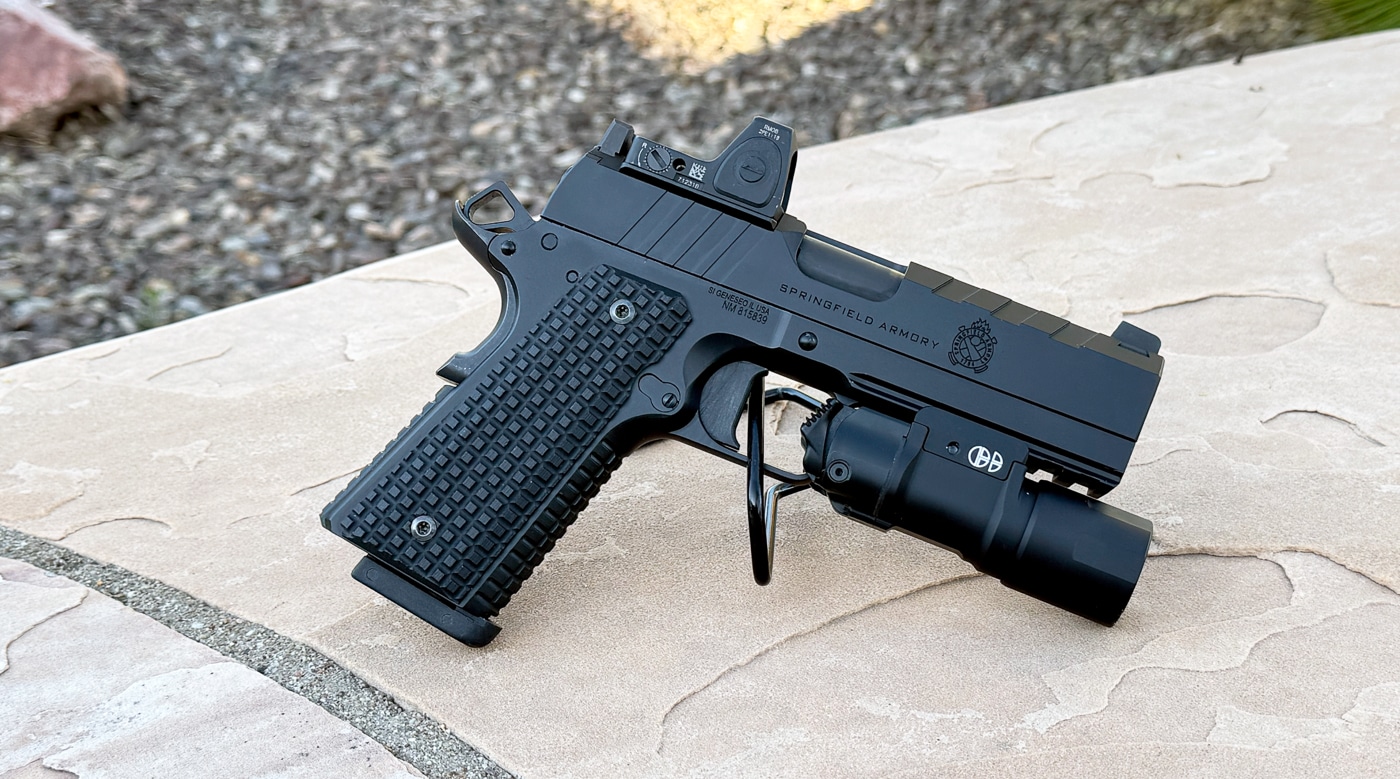
The all-black treatment works in its favor and gives the pistol a disciplined, understated presence. It feels modern without leaning into trends, and it looks refined without losing the sense that it’s meant to be used. That balance isn’t an easy one to hit, but this one gets it.
Personal and Practical
The 1911 platform itself carries some personal history for me. It was the first pistol I was issued during my military service. It wasn’t some perfectly tuned example — it rattled, it wasn’t pretty — but it worked when it needed to. That matters. So, when I look at something like the Emissary, I’m not just seeing a modernized handgun. I’m looking at a platform I’ve spent real time with, updated for how people actually run pistols today.

Live The Armory Life. The latest content straight to your inbox plus an automatic entry to each of our monthly gun giveaways!
And that’s really where this gun lives. It respects the original design, but it doesn’t get stuck there.
Specifications and Configuration
On paper, the Emissary 4.25″ AOS 9mm is a 4.25”-length 1911 with a forged carbon-steel slide, forged stainless frame, a 4.25-inch match-grade bull barrel. It also features Springfield’s Agency Optic System (AOS). It ships with G10 grips, a tritium front sight, a black serrated rear, and two nine-round magazines. Weight sits right around 42 ounces unloaded, putting it squarely in that Commander-size category. MSRP is $1,392.
Those specs only matter if they serve a purpose, and in this case they do.
Why This Length Works
A 1911 with a 4.25”-length barrel has always made sense. You get most of the stability and shootability people like about a full-size gun, but in a package that feels a little quicker and a little easier to manage. It’s not cut down to the point of compromise, and it’s not so large that it becomes locked into one role. It sits in a practical middle ground, and that’s part of why this format has stayed relevant for so long.
Optics Integration
The AOS system is one of the more important modern updates here. Springfield worked with Agency Arms on it, and it allows you to mount multiple optic footprints using interchangeable plates, each with an integrated rear sight. That last part matters more than people give it credit for. Maintaining a usable sight picture without having to completely rethink your setup is a smart move.

And realistically, a modern 1911 that ignores optics altogether is starting to feel dated. The Emissary doesn’t fall into that trap. It keeps the identity of a 1911 intact, but it acknowledges how a lot of shooters are actually configuring pistols now.
Practical Tradeoffs to Consider
That said, there are a few practical realities that come with this platform.
First, capacity. This is still a single-stack pistol. That’s part of the design, and for some shooters it’s part of the appeal. It’s slim, familiar, and true to the original concept. But it is a tradeoff. In a market filled with increased-capacity options, nine-round capacity is something you need to consciously accept going in.
Second, controls. On my sample, there’s no ambidextrous safety. For right-handed shooters, that’s likely a non-issue. For left-handed shooters or anyone who strongly prefers ambi controls, it’s something worth considering before making a decision.
The slide is another area where form and function intersect. Springfield leans into the tri-top design and clean lines, and visually it works. It’s a big part of what gives the Emissary its identity. In practice, though, the serrations aren’t as aggressive as some other modern pistols. Not a flaw, just a characteristic.
Range Performance
Those are the kinds of details that stand out when you’re looking at a pistol from a practical-use perspective.
Once I got this out on the range, the performance lined up with what the build suggests.
This pistol is accurate — flat out.

Not “good for a 1911,” not “good for the price” — just consistently, repeatably accurate. It’s one of those pistols where you’re not fighting it at all — you’re simply confirming what it’s already capable of doing.
A big part of the pistol’s recoil behavior comes down to the weight. At just under 47 ounces loaded, this is not a light pistol — and it doesn’t try to be. That heft works in its favor. The gun stays planted. There’s no drama in the recoil impulse. No porting, no compensator — just mass and gravity doing the work of keeping the muzzle rise down.
You feel that immediately.
The pistol tracks predictably and settles right back where it needs to be. This is not a competition shooter, and I wasn’t trying to run it at breakneck speeds. But what it gives you instead is consistency. Shot after shot, it behaves the same way. And that consistency translates directly into accuracy.
Grip and Trigger
The grip texture is another standout. Springfield went with that hand grenade-style pattern, and I’ll be honest — that name doesn’t exactly sell confidence for me at first. But in practice, it works. It locks into the hand without being overly aggressive and gives you a very secure purchase during strings of fire.
And there’s a bit of irony there — the last thing you want is a grenade in your hand for too long. In this case, though, it’s exactly what you want. It feels controlled, planted and reliable.
The trigger is exactly what you’d expect from a solid 1911. Smooth take-up, a clean break, and a reset that returns right where it should. Nothing exaggerated, nothing unpredictable — just consistent and dependable.
Durability and Real-World Use
And then there’s the part that actually matters long-term.
During range testing, the pistol hit the ground. Not ideal, but it happens. And instead of pulling it out of rotation, it stayed in the mix. The result is what you’d expect — a little marring, some wear, the kind of marks that come from actually using the gun. It’s not pristine anymore, and that’s fine. This is a working pistol. It’s earned its stripes.
And honestly, that tells you more than a perfect range session ever will.

That same perspective carries into how I evaluate any pistol long-term. I don’t rush conclusions. Plenty of handguns can impress you in the first magazine. That doesn’t mean much. A clean first impression can hide a lot. My baseline is around 300 rounds before I start forming a more solid opinion. By that point, a pistol usually shows whether it has substance or if it was just putting on a good first impression.
A 9mm 1911 is also something that still gets debated more than it probably should. From where I sit, it doesn’t need defending. It makes sense. Lower recoil, cheaper ammunition, faster follow-up shots, and a more forgiving shooting experience all have real value — especially for someone who actually spends time training.
You still get what makes the 1911 appealing in the first place: the trigger, the ergonomics, the way it sits in the hand. Pair that with 9mm, and it becomes easier to take advantage of those strengths without fighting unnecessary recoil.
Value
Price is part of the conversation as well. The Emissary sits in that middle-to-upper production 1911 space. It’s not entry-level, but it’s also not pushing into full custom territory. At that point, buyers expect more than just a recognizable name. They’re looking for refinement, but they still want something that makes practical sense.
This pistol makes a very reasonable case for itself in that category. Add to that Springfield’s lifetime warranty, and you have a lot of gun for the money.
Final Thoughts
So who is it actually for?
To me, this is for the shooter who appreciates the 1911 platform but doesn’t want to ignore the last hundred years of development. Someone who still values a clean single-action trigger and a steel-frame pistol, but also wants optics capability and a setup that works in a modern context.

It’s not trying to replace increased-capacity platforms. It’s not trying to compete with race guns. It’s doing something different.
It’s a refined, modern take on a proven design that still holds up.
From a service-grade perspective, that’s what I’m looking for. Not perfection, not hype — just a pistol that feels coherent, well thought-out, and capable of doing what it’s supposed to do once the round count builds.
The Springfield Armory 1911 Emissary 4.25″ AOS 9mm checks a lot of those boxes.
It looks refined without being overdone. The all-black finish gives it a serious, no-nonsense presence. The single-stack format keeps it grounded in the original design. The slide favors clean lines over aggressive serrations. And the AOS system makes it feel far more relevant in today’s optic-driven world.
Like that Porsche comparison, it works because it respects the original while still moving the idea forward.
And in a market where a lot of pistols try too hard to prove something, there’s something to be said for one that simply shows up, does its job, and lets the performance speak for itself.
The foundation is there.
Now it just comes down to what happens when you put real rounds through it.
Because that’s where the real review begins.
Editor’s Note: Please be sure to check out The Armory Life Forum, where you can comment about our daily articles, as well as just talk guns and gear. Click the “Go To Forum Thread” link below to jump in and discuss this article and much more!
Join the Discussion
Featured in this video

Read the full article here