

This article was originally published by Matt Hisrich at The Mises Institute.
While reading The Wealth of Shadows—Graham Moore’s excellent historical novel about pre-World War II global finance—I couldn’t help but feel a growing sense of unease regarding the current state of international economics. Set just before the United States enters World War II, the book follows the adventures of a plucky group of Treasury Department employees unofficially working to undermine the German economy while officially maintaining the US position of neutrality.
Two figures outside of the US loom large in the narrative—Hjalmar Schacht in Germany and John Maynard Keynes in England. Schacht is labeled “The Dark Wizard of International Finance” and credited with the “economic miracle” of Germany moving from an impoverished post-WWI economy to an industrial war machine capable of mowing down all of its neighboring countries. Keynes is lauded as the savior of the British economy emerging out of WWI in a position of strength and having predicted the rise of a totalitarian Germany as a result of the Versailles Treaty reparations imposed on the country. While the US is, at this point, by far the world’s mightiest economic engine, the book claims no equivalent economic mastermind here.
The protagonist of Wealth of Shadows is a character based on the real-life lawyer named Ansel Luxford. Luxford is in awe of Keynes and serves as a mediator between Keynes and his American counterpart, Harry Dexter White. While Luxford eventually becomes disillusioned with Keynes’s plans for a world currency, he nonetheless takes to heart Keynes’s idea that money is simply a fiction people choose to believe in and that the government can print as much of it as it wants for the projects they wish to undertake. This is interesting in part because it is Luxford who recognizes that when Germany does this, it becomes a sort of pyramid scheme that can only be sustained by ongoing conquest. This realization never gets applied to any other country.
There is certainly truth behind the claim that fiat currency has nothing behind it but the faith of its users. Economists of the Austrian School, such as Ludwig von Mises and Murray Rothbard, consistently advocated for a gold standard precisely for this reason. As Jörg Guido Hülsmann shares in his biography of Mises, Mises saw firsthand printing presses running nonstop, day and night, to keep up with out-of-control inflation in the Austro-Hungarian Empire. Keynes’s character argues in Wealth of Shadows that gold is just a rock, and he’s not wrong that it does not have inherent worth. But its use is not in its inherent value, but rather as a constraint on governments’ ability to abuse the power to print money. Requiring governments to back their currency up with something places a limit on what they can spend—and therefore a limit on the favors they can purchase from voters or special interests. No wonder politicians and government officials prefer Keynesians (and their latest incarnation under so-called “Modern Monetary Theory”) to Austrians.
But part of the mystery in Wealth of Shadows is how governments can circumvent the price inflation that comes from excess printing—to have their cake and eat it, too, so to speak. How was the German government able to afford to reduce unemployment through work projects, buy and manufacture war material on a massive scale, and go to war against multiple countries, all at the same time? Luxford explains that Germany had created a fictitious company that issued debt, which it forced banks to take and then paid out interest into German savings accounts, out of which Germans were prohibited from withdrawing. Luxford goes on to note that this system only works because of the controls imposed on citizens and the constant influx of seized assets from both Jews internally and conquered countries (and their Jewish citizens) externally. Theoretically, he says, the economy would collapse once Germany was either defeated or took over the entire world.
But despite acknowledging the Ponzi scheme nature of what Germany was doing, Luxford advocates a similar, albeit voluntary, approach to floating US war bonds. And, under the guidance of Keynes, he embraces the idea that the US government can buy whatever it wants as long as people believe in the value of its currency. Harry Dexter White argues in Wealth of Shadows that what makes people believe in the dollar is that it is backed by guns. The global order attests to that. It is also backed by political and economic might. It is truly a wealth of shadows—an illusory fiction whose bill must be paid eventually.
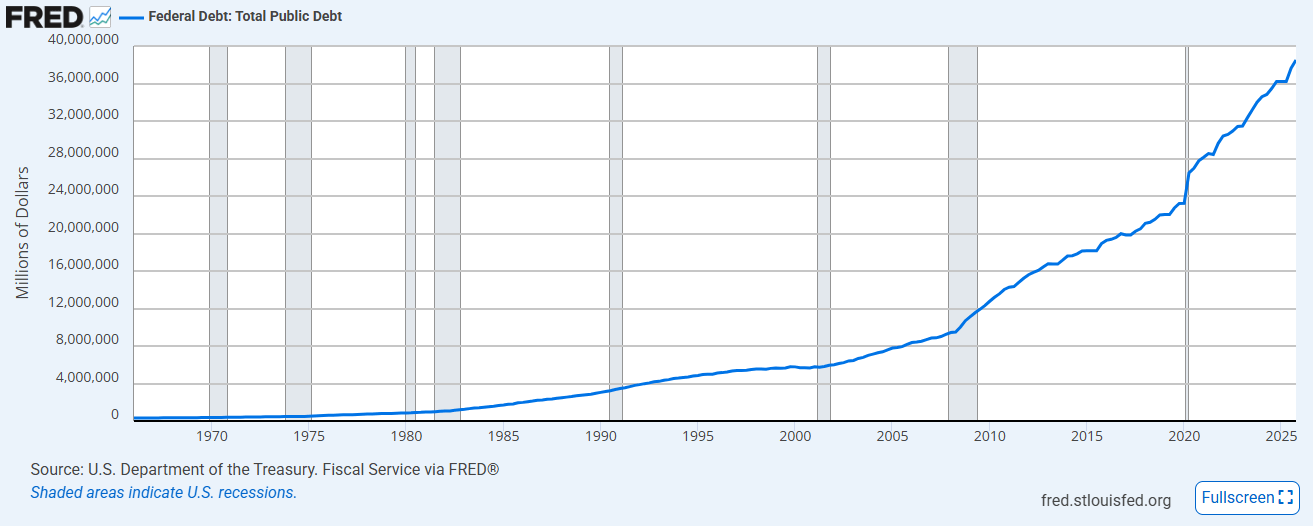
Federal Reserve Chair Jerome Powell recently made this explicit when commenting that the nation’s debt load of $39 trillion is “not unsustainable,” but “will not end well if we don’t do something fairly soon.” He argues that “as the issuer of the world’s reserve currency and home to the deepest capital markets,” the US “can sustain a far larger debt burden than smaller economies.” What happens when we start losing the confidence game? The Federal Reserve Bank of St. Louis maintains a sobering chart library of federal debt overall, as a percentage of GDP, and owned by foreign governments and others. Each chart is breathtaking:
As the article about Powell’s statements observes, there is, of course, a deep irony to this warning coming from the Federal Reserve, which perpetuates a system built on fiat currency. In 1963, Rothbard presciently warned in What Has The Government Done to Our Money? that,
The prospect for the future is accelerating and eventually runaway inflation at home, accompanied by monetary breakdown and economic warfare abroad. This prognosis can only be changed by a drastic alteration of the American and world monetary system: by the return to a free market commodity money such as gold, and by removing government totally from the monetary scene.
Such a solution seems as unlikely to occur in 2026 as it must have in 1963 when the US national debt was $306 billion instead of $39 trillion. But how long can we realistically spend as though there’s no tomorrow? Keynes infamously dismissed economic concerns about future consequences in 1923 with his quip that, “In the long run we are all dead.” Over a hundred years later, are we living in the long run yet?
Read the full article here


